Read the supply, vesting, eligibility and payment rules before participating.
Allocation and vesting
Term
Published parameter
Supply cap
420,000,000 Cannabis
Community allocation
99% — 415,800,000 Cannabis
Founder allocation
1% — 4,200,000 Cannabis, locked at creation and released linearly over 24 calendar months from the common public opening
Community claims
420 once per eligible verified person; up to 990,000 people
Service fee and payment rules
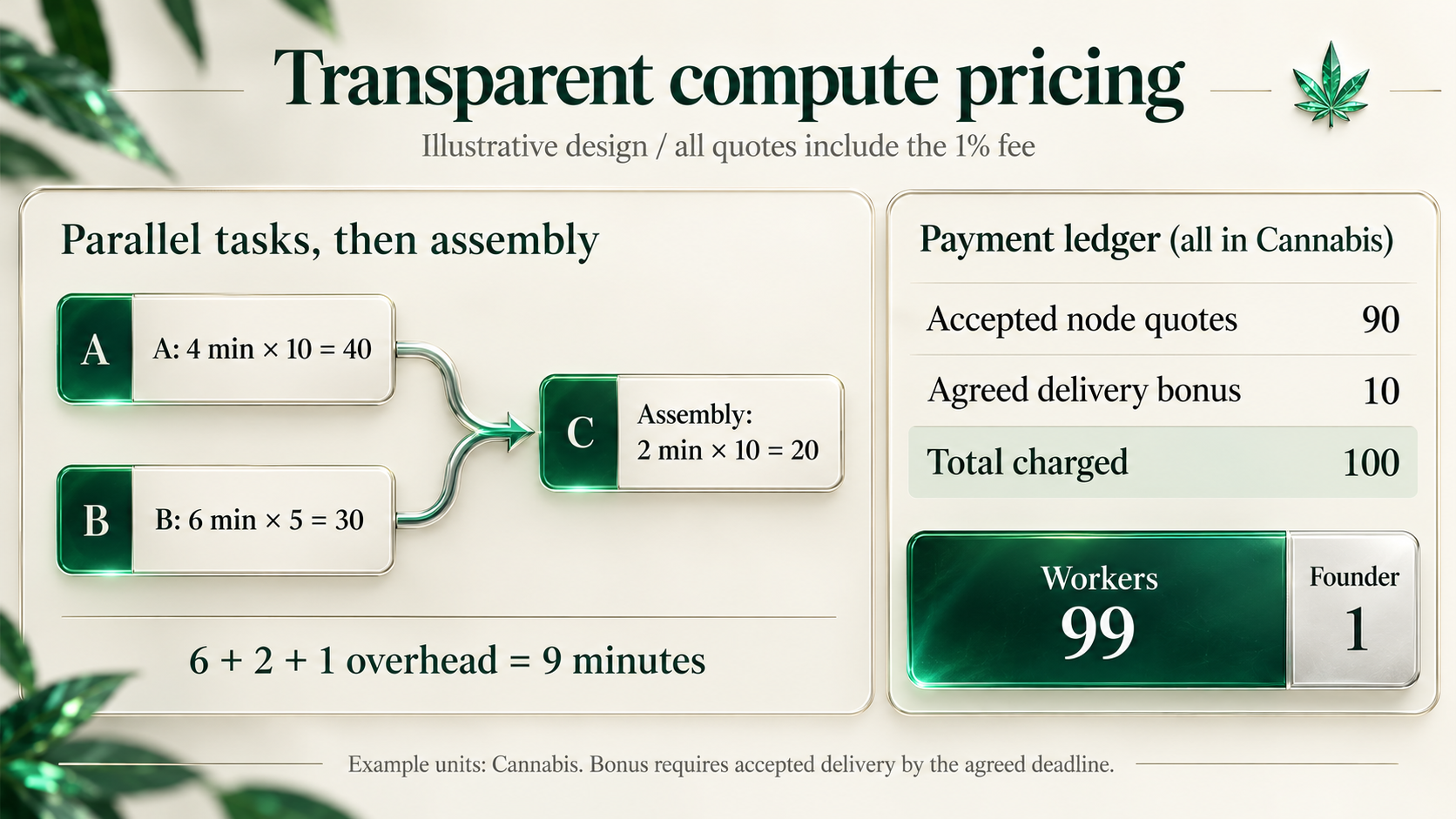
The founder service fee is 1% of accepted paid work, included in the gross job budget and separate from the founder token allocation. An accepted payment of 100 Cannabis distributes 99 to workers and 1 to the founder. Refunded amounts incur no founder service fee. Network transaction fees are separate.
Quotes and payment preparation show the fee, worker amount and total before the requester commits funds. Read the review-window, dispute, cancellation and refund rules before submitting a job.
These parameters describe the current implementation. Mainnet deployment, enrollment and protected worker operation remain in preparation; independent security and privacy review is outstanding.
Allocation and payment guides
FILM 03
One person. One claim.
FILM IN PRODUCTION
Read the film text
Ninety-nine percent of the capped Cannabis supply is allocated to community claims. The published design gives four hundred and twenty tokens to each eligible verified person, once.
Up to nine hundred and ninety thousand people can participate. Everyone starts from the same public opening time.
A zero-knowledge membership proof checks eligibility while keeping the underlying membership identity out of the public claim. Enrollment will open after the verification provider and launch requirements complete review.
Cannabis has a fixed maximum supply of four hundred and twenty million tokens. Ninety-nine percent is reserved for community claims.
The founder allocation is one percent: four point two million tokens, locked at creation and released gradually over twenty-four calendar months from the public opening.
That schedule is written into the contract design. The separate compute service fee is one percent of accepted paid work. Explore the source and see how the rules fit together.
FILM 07
From a task graph to your result
FILM IN PRODUCTION
Read the film text
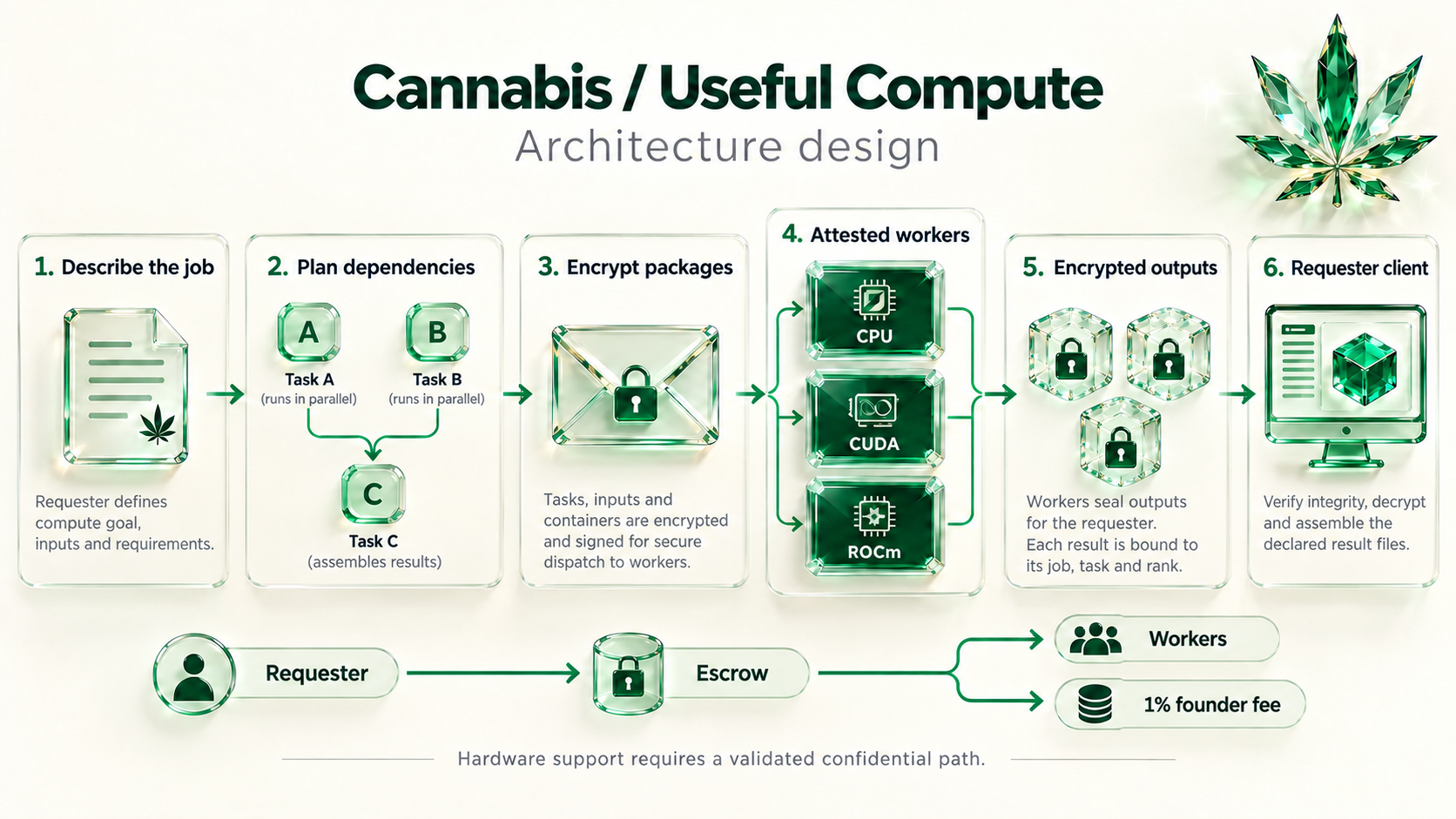
A Cannabis computing job begins with its dependencies. Independent tasks can run together. Tasks that need earlier outputs wait until those outputs are ready.
The client packages the workload and encrypts its private contents. Candidate placement matches runtime, memory, accelerators, quoted cost, and delivery estimates.
The protected execution design returns encrypted outputs bound to the original job. Your client verifies their integrity, decrypts them, and reconstructs the declared result files. Custom merging logic must be declared and run in an approved environment.
Fair compute pricing starts with clear quotes. Each provider declares the resources, expected delivery time, and price before the requester commits a budget.
The proposed pricing model can include a delivery bonus, agreed in advance and earned only when the complete result meets the deadline and acceptance rules.
On the Cannabis network, an accepted payment of one hundred tokens sends ninety-nine to workers and one to the founder. Refunded amounts earn no founder fee. Estimates guide selection; verified results and agreed terms determine acceptance.
The Cannabis escrow contract implementation records the budget, worker shares, deadlines, review period, and dispute resolver before work begins. Every worker must accept the terms.
A requester reviews the encrypted delivery and can approve it or open a dispute. The contract also defines cancellation, refunds, and timeout outcomes.
Pay attention to the review window: an undisputed delivery becomes payable when that window expires. The contract still needs independent review and deployment. Read the payment guide, understand the terms, and help build a dependable service.
Cannabis is being built as money for useful computing, connecting requesters who need services with providers who earn for accepted delivery.
Each provider offer specifies the service, price, availability and delivery terms. The reservation system must prevent overbooking, while protected workers return encrypted results for your client to verify and assemble.
The founder receives one percent of accepted payments. Service backing requires available capacity and fulfilled provider commitments. These integrations are being prepared, and you can help develop the economic design.
From your job to your result
Declare the task graph, encrypt the package, use attested workers, then verify, decrypt and assemble outputs on your own client. Payments flow from requester to escrow to workers, with the disclosed founder fee.
Illustrative arithmetic: worker subtotals of 40, 30 and 20 plus an agreed completion bonus of 10 give a gross budget of 100. An accepted payment sends 99 to workers and 1 to the founder. These are explanatory numbers, not live market quotes.